Prevention
A lameness prevention strategy should be based on the following:
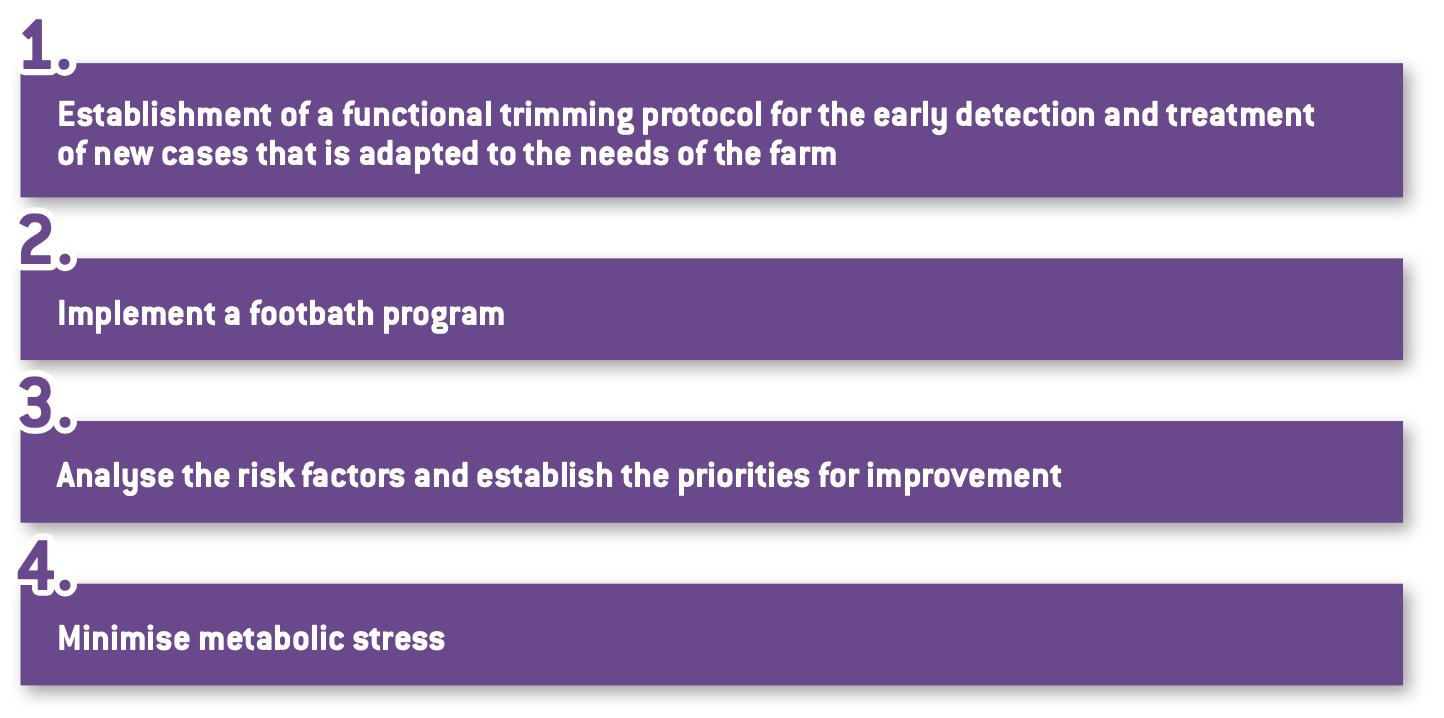
Vets and foot trimmers in the U.K,. tend to recommend the 5 Stage Trim. Comprehensive details of a functional trimming programme can be found in this lameness booklet (PDF) or contact The National Associate for Foot Trimmers (NAFCT) to find a registered trimmer near you.
Risk factors should be analysed on farm in order to be able to fix or manage a situation.
Footbathing
The regular use of footbaths is thought necessary in most dairy farms in order to effectively control dermatitis. These are most efficient when combined with other measures for comfort and hygiene.
The following factors must be considered:
1. Placement
The bath is usually placed at the exit of the milking parlour at a sufficient distance so that it does not obstruct the flow of the animals and does not emit fumes that could affect the milking technicians.
2. Design
Ensure that the cow passes through it with all four feet, that it is of a minimum width, and that the container walls prevent splashing in order to retain the product.
3. Disinfectant
Make sure that it has a reasonable cost-efficiency ratio and that it is the least harmful possible to the workers and animals. The most popular products are copper sulphate, although this presents problems of environmental pollution caused by its accumulation in the soil, and formalin which emits vapours and is considered a carcinogen and so its use should be avoided or reserved for very specific situations and should be used with extreme caution in very ventilated areas.
4. Dosage
For this it is important to know the real capacity of the footbath; it is better to use a lower dose and increase the bathing frequency. Both copper sulphate and formaldehyde are usually used in a 5% solution.
5. Dosage
The footbath should be used as a preventive and so a routine that changes in each barn, and in which its frequency of use varies from once a week to every day, should be followed.
6. Dosage
This will also depend on how the hooves are cleaned upon entering the shed, but the bath is typically changed every 300 cows.
7. Temperature
This mainly affects formalin; at temperatures below 10oc formalin is inactivated and at high temperatures it can cause burns (in this case the dose should be lowered). Where it is affordable, automatic footbaths that are programmed are ideal and produce excellent results.
Antibiotics should not routinely be used in foot baths.
Reducing metabolic stress
The transition period is a time of great metabolic stress. If cows stand for too long during this time, foot problems can increase. A stress-free calving can decrease the chances of getting lame during the whole lactation.
Findings suggest that cows which lose a lot of body condition during early lactation, and also lose a lot of their capacity to absorb shock through their feet fat cushioning system, thus increasing their risk of lameness.
To minimise metabolic stress and to promote proper horn growth, trace minerals and vitamins may be useful.
The most important part of the foot health program is to create a protocol for the early detection and treatment of lame cows. This will have a huge impact on the welfare and production efficiency of dairy cows across the U.K.


