Treating and managing lameness
The initial diagnosis of any disease of the foot should be made, and then treatment managed, by a veterinary surgeon. The condition may require regular foot trimming and medicines prescribed by your vet to treat any pain, inflammation and infection.
Restraint and Tools
Foot trimming should be done by a qualified professional and safety is key for the trimmer, farm team and cow. As such, it is important to find a restraint system that works for everyone.
1. Manual restraint
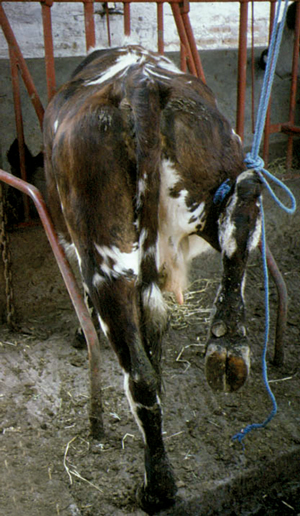
The hindlimbs can be raised with the aids of a rope by making a sliding knot with a loop or a tourniquet using a stick placed just above the hock. Thus, the cow maintains four points of support and the operators do not have to overexert themselves. This type of fixation is useful for isolated individual cases, very little material is required but the work could be dangerous and difficult. The use of anaesthesia is essential for painful treatments.
2. Mechanical restraint
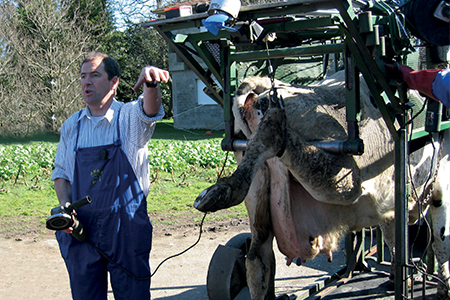
There are a number of systems used for effective restraint, including the Dutch Style ‘Cow Crush’, the Tilt Table and the Stand-Up Crush, Double Belly Band. Each has their advantages and disadvantages and farmers must decide which works best for them.
3. Tools
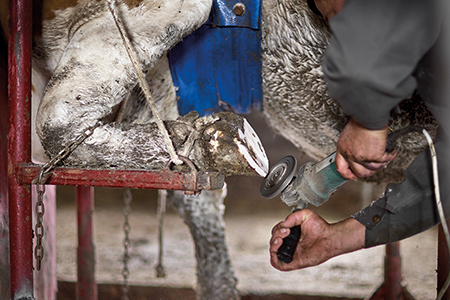
The basic tools for trimming hooves are hoof knives and pincers, and it is important to always work with sharp, clean hoof knives. The use of electric grinders and specific trimming discs is becoming more widespread because they are faster, more comfortable and easy to use, but should only be handled by skilled, trained operators. The use of electric tools is not recommended with manual restraint.
Trimming
Each individual animal needs different attention. For most intensive production cows, preventive trimming once or twice a year is beneficial, however, others may never need hoof trimming. Animals that have suffered some type of disease in their hooves (especially a chronic disease), or which have deformations, usually require more attention.
Functional Trimming
Functional Trimming: to restore hooves back to their natural state which may have changed as the animal adapts to its environment. It is very useful to follow the routine trimming guidelines, thus always avoiding hurting the animal. The general guidelines explained below are applicable to the Holstein Friesian breed, however, the trimming must be modified according to the breed and the age of the animal.
The Dutch 5-Step method for trimming feet is the internationally accepted approach. This is best attempted after a specific training programme has been completed.
Steps 1-3 of the 5-step method is primarily the functional trim:
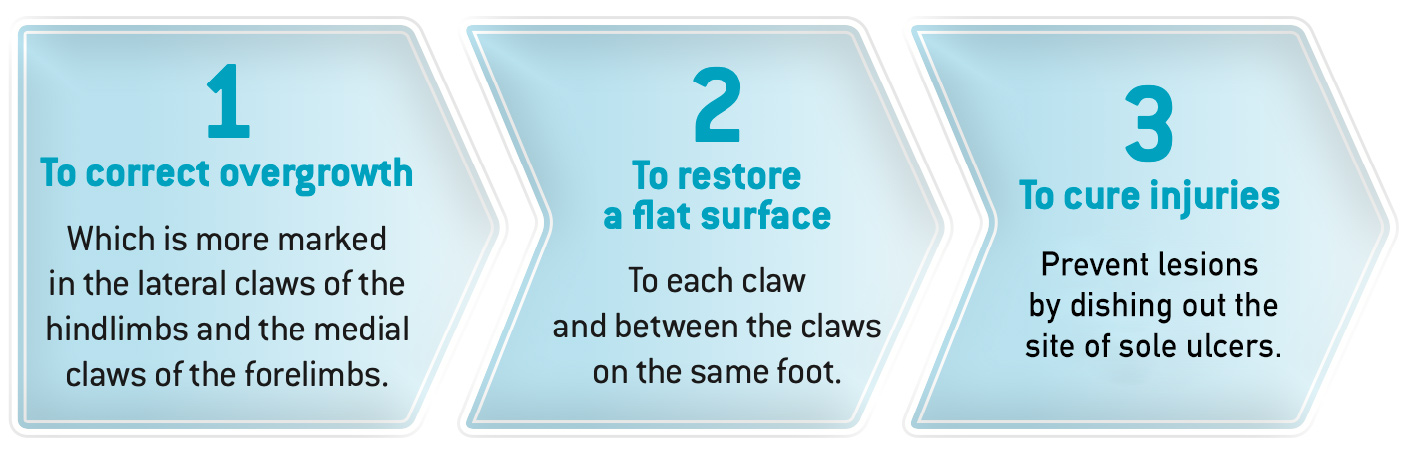
- STEP 1: Trim toe to correct length - start with the inner claw of the hind foot and the outer claw of the front foot. Remove excess sole down to 5–7mm. Avoid trimming the rear of the sole in order to maintain heel height and keep the toe level. Avoid over trimming and stop if unsure.
- STEP 2: Match untrimmed claw length - repeat the process for the outer the claw, levelling up to the inner claw. Normally more horn has to be removed from the outer claw. Only minimal horn is removed from the inner claw to retain weight-bearing.
- STEP 3: Model (dish) out sole ulcer site – the inner parts of both claws (behind the wall on the inner claw edge) to allow a flow of slurry and mud between the toes and to reduce weight-bearing on the typical sole ulcer site (inner wall of the claw). Again - avoid over trimming as this could result in uneven weight bearing.
Therapeutic Trimming
Therapeutic Trimming: or corrective trimming is required if there are issues with the foot. Therapeutic trimming should be carried out by a veterinary surgeon or trained professional and is usually combined with other treatments options.
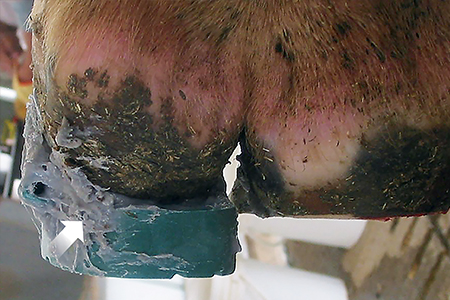
- STEP 4: Relieve weight off painful claw - to create a height difference for a painful claw so injured parts bear less weight and are allowed to recover. In most cases horn is removed from the back 2/3 of the outer claw. A block is often applied to the sound inner claw to create a height difference. Non-Steroidal Anti-inflammatory Drugs (NSAIDs such as Ketofen®) are often useful at this point to provide pain relief and reduce inflammation – consult a veterinary surgeon for more advice.
- STEP 5: Remove loose/under-run horn and hard ridges - especially from high risk zones, such as the heel (this is particularly important in cases of heel erosion). Beware of removing too much weight-bearing surface from the bulbs of the heel. Check between the claws and at the heel for digital dermatitis.
In all cases avoid damaging health, live tissue and ensure there are no cavities with diseased tissue that could cause a recurrence.
For more information on foot trimming, consult the NADIS website or AHDB.
Medication
Non-Steroidal Anti-inflammatory Drugs (NSAIDs) such as ketoprofen (Ketofen® Ceva Animal Health) can be used alongside functional trimming and the application of heel blocks, in case of non-infectious hoof diseases such as ulcers and abscesses. Not only does this improve welfare for lame cows, but it improves recovery rates.
A study from the University of Nottingham1 looked at the different ways of managing lameness associated with claw horn disease (sole ulcers, white line disease and sole haemorrhage) in the hind foot, to see which resulted in the quickest and most complete recovery. The table below compares the cure rates (defined as score 0 or 1) after 35 days, of 183 cows following one of four different treatment options.
| Treatment | Trim Only | Trim & Block | Trim & NSAID* | Trim, Block & NSAID* |
| Cure Rate | 69% | 72% | 76% | 85% |
| * Ketoprofen for 3 days | ||||
85% of the cows treated with foot trimming, a block and ketoprofen were non-lame after 35 days, which was approximately 10% better than the next best treatment combination.
Prompt detection and early, effective treatment are the two major factors that affect the outcome of severe lameness.
Antibiotics
Antibiotics can be used topically (sprays) or systemically (injection) but should always be prescribed by a veterinary surgeon as each condition responds better to a different type of antibiotic. Antibiotics should never be used routinely in a foot bath.
Bandaging
Some vets will recommend bandaging to help manage specific conditions, such as digital dermatitis, but they need to be removed after treatment is complete, so handler safety should be considered.


